Parashah Shemini 2019 (the 8th day) Leviticus 9 – 11

This parashah picks up from last week’s reading, where we left Aaron, Nadab, and Abihu in the Tent of Meeting for 7 days as part of their anointing to be Cohanim (Priests) to the Lord.

If you prefer to watch a video, click on this link: Watch the video.

Now, on the eighth day, they are to perform a series of sacrifices to complete their anointing ritual, but after doing so Aaron’s two sons present their own incense before the Lord, which was not part of the ritual, and the punishment for that was their immediate death. Moses commands that drinking alcoholic beverages when serving the Lord is forbidden, which the rabbis have understood to mean that Aaron’s sons were drunk, causing their irrational and sinful behavior.

The next chapter, Chapter 11, is the one that gives the instructions for Kashrut, the kosher regulations.

This is probably one of the most argued against instructions in the entire Bible. Christians have misinterpreted Mark 7 and Acts 10 for centuries as doing away with these instructions; even within Judaism, Reform Jews (within my experience) generally do not keep Kosher and many Conservative Jews I have known may maintain a kosher home, but when outside their home will disregard these instructions.

Rabbinical thought categorizes the Kashrut instructions as Chukim, which are regulations we are expected to obey, although the reason for them transcends human understanding.

We can know this one thing about the instructions in Leviticus 11: they help to make us holy, where holy means to be separated.

I keep kosher according to the instructions in the Bible, but I am not kosher according to the rabbinic regulations in the Talmud, which greatly expand the ones in this chapter. As such, I can tell you, absolutely, that I am separated from those who do not maintain this diet.  For instance, when I go to an Italian restaurant I have to ask if there is pork included in the meat that they use for their lasagna and meat sauce. For breakfast, I have to double-check that there is no bacon fat added to the home fries, which many chefs use to enhance the flavor. When going out for breakfast, I know the turkey sausage I order will probably be cooked on the same grill with the regular sausage, but the heat of the grill is enough to destroy the treif (Yiddish for unclean) germs left behind. The fact that the heat of the grill makes it OK to have kosher next to treif comes from the same reasoning the Rabbis give for using the same plates for meat and dairy (fleishig and milchig), so long as the dishwasher is hot enough to sterilize the dinnerware.

My obedience to Kashrut is what separates me from the rest of the patrons, and when asking about the food preparation I have an opportunity to demonstrate obedience to God’s instructions and (maybe) set an example to others.

What presents a serious problem, to me, is when people argue about why certain animals are kosher and why others aren’t. The problem I see with this is that it shows a need to know why God does something.  We are allowed to question God, but this human need to know everything works against faith.

Faith is believing that which can’t be seen or proven, and I believe when we have to know “why” it represents a lack of faith: I say this because by having to know why we apparently don’t trust that God will only have us do that which is good for us. When it comes to obedience to the instructions God gave us on how to live, worship and treat each other, I think we should follow the motto from the Nike shoe company: Just do it!

I am not saying we cannot ever question the Lord; he is big enough and compassionate enough to allow this. My concern is that constantly questioning God’s reasons might result in losing faith when we don’t get the answers. This is what the writer of Kohelet (Ecclesiastes) found out- trying to understand God at God’s level is like chasing the wind. It was impossible and resulted in disappointment and depression.

Obedience to the instructions in Chapter 11 of Leviticus, as well as any other instructions God gave to us throughout the Torah, should not be based on understanding the reasons why God gave them. Obedience for the sake of obedience is what many think will help us earn our entry into heaven- it won’t. This is what I call “Performance-based Salvation”, and is the “legalism” that Shaul spoke against when he wrote to the congregation in Galatia.

Obeying the instructions for Kashrut (as well as every other instruction in the Torah) should be based solely on faithfully accepting that God would not tell us to do anything other than that which is good for us. He says, over and over throughout the Tanakh, that we should obey so that we will live. He doesn’t mean live this life but to live eternally with him. When we are truly faithful, that faith generates a desire to obey. The more faithful, the more obedient.

What is really sad is that there are many, many people who do have faith, but their obedience has been stifled with wrongful teaching through traditional Christian (meaning Constantinian) doctrine that was not designed to honor God. Neither was it created by the early ‘church” fathers to separate Christians from the unholy, but to separate Christians from the Jews.

God sent the Messiah to bring all people back to God, but men have distorted that event into further separating people from God by teaching disobedience.

Each one of us has the right to choose what we will do. God has given us all the instructions he wants us to know, which are all the instructions we need to know. And we do NOT need to understand why he has given any of them, we just need to faithfully accept they are what is best for us, and obey them. God has said many times in the Tanakh that he has presented to us life and death, and tells us to choose life, that we may live.

So, nu? You can choose life or death- which one do you want?

Thank you for your interest and please share me out to help this ministry grow. Also, don’t forget to SUBSCRIBE by clicking on the button in the right-hand margin. Also, use the link above to subscribe to my YouTube channel. If I get enough subscribers I will earn a little advertising money and I use that to send my books to foreign countries that are asking for hard copy (it cost me over $100.00 to send 6 books to Uganda earlier this year.)

Tonight is Shabbat so Shabbat Shalom, and until next time…L’hitraot and Baruch HaShem!
Using Shaul’s Letters as a Weapon Against the Torah

The New Covenant writings are the historical record of Yeshua’s ministry and teachings, as well as a narrative of the travels (and travails) of some of the Apostles. The majority of the New Covenant is made up of the Epistles (letters) written by Shaul (Paul) to the congregations of Messianic/Believing Gentiles that he founded throughout Asia.

If you prefer to watch a video, click on this link: Watch the video.

These letters have been used to form much of the doctrine of modern, or Constantinian Christianity, and are considered, by many Christian denominations, to be more important than God’s instructions in the Torah.

I liken it to Judaism and the Talmud: the Orthodox and Hasidic sects of Judaism will often go to the Talmud for spiritual guidance before they go to the Torah; in fact, the rabbinic doctrine in the Talmud is called Halacha- the Way to Walk. Most Jews live more in accordance with opinions from the great Rabbis written in the Talmud than they do to the instructions God gave us in the Torah.

The same thing has happened with the letters Shaul wrote, except for one major difference: the Talmud tells us how to live in accordance with the Torah, whereas each letter from Shaul addressed only specific problems within the congregation he wrote to. His references within his letters to the Mosaic Law were never intended to tell people they were no longer necessary or valid for Gentile Believers, but to explain that they are not the path to salvation (anti-legalism) but the result of a faithful desire to please the Lord.

The instructions Shaul gave to his congregations was supposed to be used as a weapon, loaded with bullets from the Torah to shoot down and kill the wrongful teachings and ideas that were infiltrating his congregations, such as Gnosticism, Legalism, incorrect understanding of the Kashrut instructions, and internal dissension caused by individual political agendas.

What happened was that the early “church” leaders took Shaul’s weapon, reloaded it with bullets of wrongful teachings and used it to murder the Torah!

We must read the letters from Shaul as what they were designed to be: not instructions establishing religious doctrine but condemnation for incorrect worship and personal relationships. These letters were addressing problems within the congregation, and instead of seeing them for what they are, Christianity has turned them inside-out and made them appear to be doctrinal commandments. That is why instead of doing what Shaul meant them to do, which was to help his Gentile Believers live in accordance to God’s instructions properly, they have been misused in order to deny the necessity of following the Torah.

It doesn’t help that it is very hard to understand much of what Shaul wrote because he used what I call “Jewish logic.” Jewish logic is how we Jews argue- we never tell you what something is until we first tell you everything that it isn’t. If you read Shaul’s letters carefully, parsing the sentences and separating thought by thought, you will see that he starts his discussion with the negative aspects (the “Anti” side) of the Torah, then he comes back to show how the things he just said might be true, aren’t.  This form of argument, as well as implied cultural and religious meanings which Jews would understand but the Gentiles couldn’t, is why it has been easy for Christian leadership to twist the intent of Shaul’s letters.

If you don’t believe me, just read the postings within Christian or Messianic discussion groups or talk to Gentiles who DO want to follow the Torah, and I will bet you dollars-to-donuts that the vast majority of passages they use to prove their doctrinal beliefs will be from the Epistles of Shaul! They won’t pull from where he quoted, the Torah, but they will use his letters as justification for what they say. When you talk to most any Christian about the Bible, they will quote exclusively from the New Covenant because most Christian teachings won’t even include the Tanakh.

When I do an Internet search for something I know is in the Torah, the majority of the “hits” I get are from the New Covenant, where the writer is quoting from the Torah but I won’t see the original passage from the Torah.

Going forward, if you have been able to see the truth in the letters Shaul wrote, that truth being confirmation of the Torah and not condemnation of it, then please help others (compassionately and with love) to see this truth, as well. And, if you are saying to yourself that what I have been saying here is a bunch of hooey, I would ask you to test my statements and read Galatians, or Romans, or any other Epistle and look specifically for the method of argument I said Shaul uses. If you are able to read these with an open mind and not-prejudging the outcome, I believe God will open your eyes to what I and many others believe is the true meaning of those letters.

Thank you for being here, and I do welcome comments and discussion- all I ask is that you be nice.

Please don’t forget to SUBSCRIBE and do so also (using the link above) to my Youtube channel.

Until next time, L’hitraot and Baruch HaShem!

Changing the Way I Talk About the Torah

The Torah is the first 5 books of the Bible, which most of you already know, and it contains all the commandments (also referred to as “laws”) God has given to us. The rest of the Old Covenant is more of a historical narration, which shows us how we have failed to live up to our side of the covenant God made with us, in which those laws reside.

If you prefer to watch a video, click on this link: Watch the video.

For Jews, there is no problem with the Torah being God’s laws because the Torah is all that almost every non-Messianic Jew in the world cares about, meaning they do not accept anything from the New Covenant as scripture or even valid.  So, for those Jews who do not accept Yeshua as their Messiah, law=Torah=commandments=regulations, and that is fine.

The problem I want to talk about today is that Christians, in general, have traditionally been taught that the Torah- in truth, the entire Tanakh- is just for Jews. Jews have the Torah and Christians have Jesus Christ.Add to that the traditional Christian teaching of the Epistles Shaul (Paul) wrote, which is that obedience to the ‘Law” is legalism and wrong because faith and love are all you need to be saved, and you have the incorrect belief that law=Torah and neither apply to Christians.

As a Messianic Jew, I understand the truth about the relationship between Yeshua (Jesus) and the Torah, in that Yeshua was (as John tells us in John 1) the living example of the way we are to live in accordance to the Torah. Not only did he NOT do away with Torah, but he confirmed it in everything he did and said.

Consequently, understanding the above I also know the truth about the letters Shaul wrote, which (again) did NOT deny the validity of the Torah, but confirmed it. Albeit, the way he did so was very convoluted and confusing to Gentiles who couldn’t grasp the underlying cultural and religious meanings of much of what he wrote.

So, what I have decided to do (which will take me a while to incorporate into my messages) is to not refer to the Torah as “law”, or “commandments” or even “regulations” (which, by the way, they are) but simply as God’s instructions to us.

When we look at how God tells us what we are to do, it isn’t so much a decree as a choice. There are way too many passages to quote, but I doubt that anyone with any knowledge or familiarity with the Bible will be surprised when I say God tells us (repeatedly) what we are to do and what will happen if we don’t. To some, this may be a decree or even seen as a threat, but to me, it is a choice.

Through all the Prophets, God constantly told his people that he wanted them to choose life so that they would live. When he says to choose life, he means to obey his instructions in the Torah. Yeshua did not give any new instructions: yes, I know he said: “I give this new command, to love one another” (John 13:34) but that really isn’t “new”- it is from Leviticus 19:18. Yeshua did not create a new religion (this is what Jews are taught), nor did he change any of the existing instructions from the Torah or do away with them (this is what Gentiles are taught), so since Torah and Law and commandments all have the same connotation to both Jews and Gentiles, I will use “instructions” because that won’t sound like the same rhetoric everyone has already heard.

Maybe, just maybe, if people take a new view of the Torah as just instruction, which we have the right to choose or refuse, then maybe they will begin to see the entire Bible in a different light, one that might shine the truth through the cloudy and darkened misinterpretations that both Jews and Gentiles have been force-fed for generations.

One last thing: there are probably some of you out there who are thinking that I am wrong to refer to God’s commandments as something that is not mandatory, and I can understand why you would feel that way.  After all, he is God, right? The Almighty! The Creator of the Universe! The holy I Am! And when God says we should do something, it isn’t a suggestion, so where do I get off saying we have a choice?  The reason I say we have a choice is, well…because God tells us we do. When God says we should “choose life” he is giving us an option. If God didn’t want us to have an option, he would have not told us we have a choice. And he would not have given us Free Will, either. But God doesn’t want automatons, and he won’t make us love him; the only thing we can give God that he doesn’t already have is our love. He wants our worship, obedience, and love for him to be our choice.

Following God’s instructions shouldn’t be done because you are afraid of punishment but as a love-response.

The Torah is God’s instructions to the world (not just the Jews) teaching us how to worship him and treat each other. It is like the instructions you get when you have to put a child’s toy together: you can do the usual manly thing and ignore them, or you can read them carefully and follow them. And for all of you (like me) who have tried to put something together without reading the instructions, you know how that almost always turns out.

The question I leave you with is this: knowing how the toy turns out when you don’t read and obey the instructions, do you want your eternal soul to end up the same way?

Thank you for being here, and if you like what you have read please share me out and help this ministry grow. Click on the SUBSCRIBE button in the right-hand margin and also use the link above to go to my Youtube channel and subscribe there, also.

I welcome comments and discussion, and all I ask is that you be nice.

I look forward to the next time we are together, and until then…L’hitraot and Baruch HaShem!

Parashah Tzav 2019 (Command) Leviticus 6 – 8

This parashah gives all the details for the submission of the different parts of the sacrifices to be presented to the Lord. Which parts go up in the fire, which parts go to which Priests performing the duties, and it ends with a detailed description of the anointing ceremony Aaron and his sons underwent when they were first anointed as priests (Cohanim) to the Lord.

If you prefer to watch a video, click on this link: Watch the video.

The book of Leviticus can be somewhat tiresome to read because there is so much minutia. Every single detail of the activities regarding the presenting of the sacrifice is covered completely. We are told which parts go to God and which parts are for the priest, what to do with the ashes, the presentation of the sacrifice and the laying on of hands, etc.  It is a rather cumbersome amount of detail to take in.

I once wondered how they could possibly remember every little detail, then realized that this was something being done daily. Every day someone would have been presenting some form of a sacrifice for some reason, whether it was guilt, sin or a vow.

I am certain that there is a message in this parashah that can affect every one of us…I wish I knew what it was. I have read this with my spiritual ears open to hear something, and I only get crickets.

You know what? Maybe that is the message: sometimes, there just isn’t anything we get from reading the Bible. Sometimes we read it just to get to the next section or chapter. And I think that’s OK.

How many times have you read something and then suddenly, one day- BAM! -you now understand exactly what God is saying in that passage and you wonder how you never saw it before? When that happens to me I think that the reason for not seeing it before was simply because I wasn’t ready to see it or to understand it.

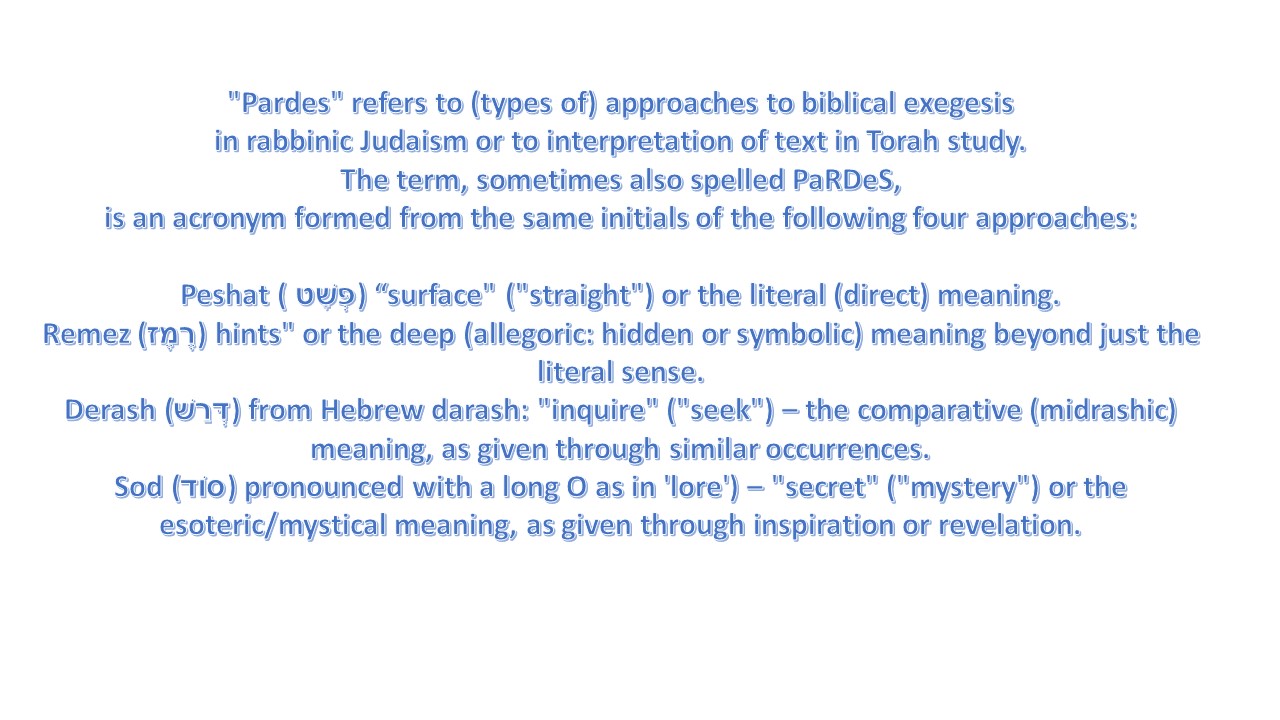
God knows our heart and our mind; he knows what we are thinking and more than that, he knows what we can understand and what we can’t yet grasp. As we grow in knowledge, we grow in understanding, and as we grow in these we also grow in wisdom, discernment, and spiritual maturity. And when we are knowledgeable and spiritually mature enough to grasp the Remes or Sud of a passage, that is when God opens our eyes to it.

If you are not familiar with Remes or Sud, click on this link to read the definition of the Jewish exegesis system of Pardes.

This is a wonderful thing because it means that no matter how many times we read the Bible, we never know what new and exciting revelation God may have in store for us.

So, nu? What are you waiting for? Finish this message and get your Bible. Start at the beginning and read a chapter or two every day. I often state that I keep my Bible in the bathroom because there I am guaranteed at least 5-10 minutes every day when no one will disturb me.

But wherever you keep your Bible, make sure it is handy and that you find 5 minutes or so every day to read a chapter.

Tonight begins Shabbat so Shabbat Shalom and may you have a restful and blessed day.

Until next time, L’hitraot and Baruch HaShem!

PS: Please don’t forget to SUBSCRIBE and share me out. I always welcome comments as long as they are respectful.

One last thing: if you haven’t done so already, please check out my entire website as I have videos, books, and pictures that you might find interesting.

Purim 2019 Message

Chag Sameach!!

Happy holiday! Last night began the festival known as Purim, which is the plural for the word Pur, meaning Lots. It is a very joyful Jewish holiday that celebrates our salvation from extinction, which was orchestrated by the hated Persian Vizier, Haman.

By the way, in case you didn’t know it, Haman was a descendant of Agog, which means he was an Amalekite, one of the ancient enemies of the Jewish people.

If you aren’t familiar with the story, it is the Book of Esther in the Bible. It isn’t very long and is the only book in the entire Bible where there is no mention of God. And that is the basis for today’s message.

If you prefer to watch a video, click on this link: Watch the video.

One of the most important parts of this story is when Mordecai (the hero) asks his niece, Hadassah (Esther, the heroine) to go to the king and try to save the Jews from the irreversible edict Haman (the bad guy) fooled the king into signing, which calls for the total destruction of all the Jews in all the 27 provinces throughout the land. Esther initially refuses because she is afraid to go to the king, and through intermediaries tells Mordecai that the law states if anyone approaches the king without him asking them to come, they will be killed- unless the king raises his scepter to allow their visit.

Today’s message is based on what Mordecai says right after Esther’s refusal to go to the king (Esther 4: 12-14):

They relayed Esther’s words to Mordechai, and Mordechai said to relay to Esther, “Do not think that you will escape [the fate of] all the Jews by being in the king’s palace. For if you will remain silent at this time, relief and salvation will come to the Jews from another source, and you and the house of your father will be lost. And who knows if it is not for just such a time that you reached this royal position.”

When Mordecai tells Esther relief and salvation will come to the Jews from another source, that source is never mentioned beyond this vague reference, but Mordecai is clearly referring to God. He is demonstrating the faithfulness that all righteous persons have in God to save his people, no matter how doomed (by human viewpoint) they seem to be. Even when we don’t mention or acknowledge God, he is there. This is what many people don’t understand about him: just because we don’t see clear and absolute evidence of the existence of God, that doesn’t mean he isn’t here. He has been, he is now, and he always will be here, whether he shows himself evident or not.

If you ask me, the reason people say they don’t see evidence of God in their everyday life is simply that they refuse to accept what they see. A flower opening at day and closing at night; bees being able to fly even though science says they are aeronautically incapable of flight; baby prey animals being able to run within an hour of birth whereas baby predators can’t hunt on their own for years; two cells coming together against immeasurable odds and from that joining nine months later a complete human being is born.

These are all miracles and evidence not just of God’s existence, but of his wonderful design. Yet, if someone wants to refuse to accept this as evidence of God’s existence, they rationalize it away convinced that just because use we can understand the science behind the event, it isn’t really a miracle.

Eyes that cannot see.

I also want to talk about when Mordecai tells Esther perhaps the reason she was chosen as queen was specifically for this moment; he is telling her that God put her where she is so she could save God’s people. In other words, God has directed her entire life just for this one moment.

When we read the Book of Jonah (1:17), it says God created a fish to swallow Jonah. Jewish tradition tells us that God created that species of fish, way back on the 5th day of creation, specifically so that it would be there when he needed it to swallow Jonah.

Talk about planning ahead!

Mordecai was certainly a faithful and righteous man: he knew that no matter what the odds were against God’s people, God would, somehow, save them. Clearly, he understood that God has a Plan, and a backup plan, and a Plan C, and probably plans throughout the entire alphabet, all of which are designed so that God’s ultimate plan will be accomplished.

This is the lesson for us from the Book of Esther: God’s is always here, he has his plans for the future and those plans will be accomplished. He has accounted for every single person and creature, each with some part to play in his ultimate plan of salvation, and we all have the option to participate or to sit it out. Esther participated, and through her, God saved his people.

But what if she had chickened out? What if she figured, even though Mordecai warned her, because she was the Numera Una queen and no one knew she was a Jew, she could slide by? If that had happened, there would be no Book of Esther in the Bible. It would be the Book of Mordecai or the Book of Ethelynn, or maybe there wouldn’t even be a book, just an entry by one of the later Prophets telling us how God overcame this threat against his people.

Have you ever wondered how many people that aren’t in the Bible might have been there if they had accepted their role in God’s plan?

Don’t be one of those who never gets mentioned. God’s plans aren’t finished yet, and even though the Bible is complete, when the End Days are ended and we are in God’s presence for all eternity, maybe then there will be a new Bible and you might be in that one. Who knows? You or I may one day be a hero for God, we just haven’t received the call yet.

So keep your ears open and constantly listening for God’s calling in your life. You never know when he may call on you to help accomplish his plan.

If you like what you have read, please share me out, buy my books and certainly SUBSCRIBE to this ministry. Click on the subscribe button in the right-hand margin and also use the link above to subscribe to my Youtube channel, as well. If I get enough subscribers they will advertise on that channel and I can use whatever (little) money I get to help send books to needy Believers throughout the world, as I have been doing already in Uganda, Malawi, and India.

I also always welcome comments, I only ask whether you agree or not, just be nice.

Thank you for being here and until next time, L’hitraot and Baruch HaShem!